


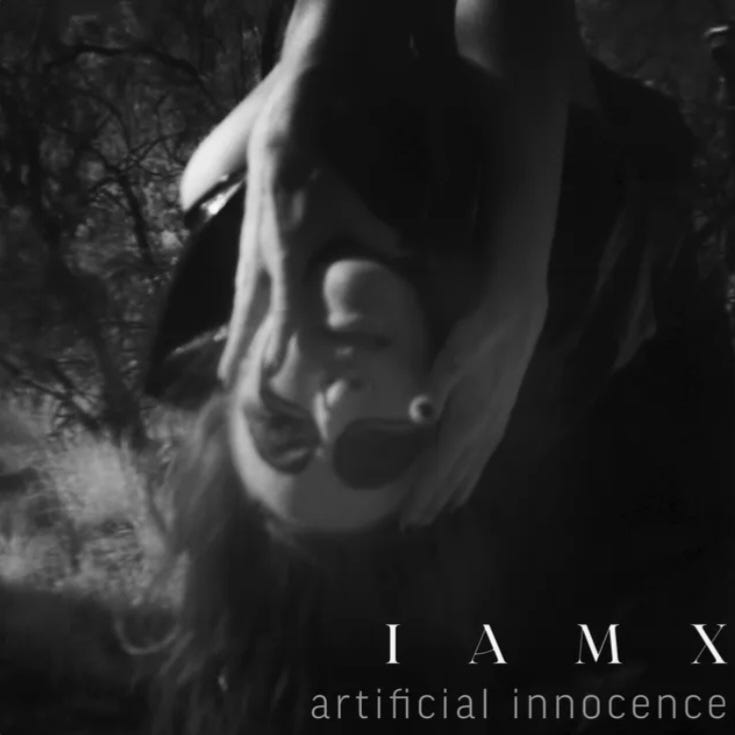
IAMX’s “Artificial Innocence” opens in a state of immediate subjugation, where autonomy has already been exchanged for something more functional and less human. Submission is not introduced gradually; it exists as a precondition, embedded into the structure of the song itself. "I serve my queen / Submit and concede” describes a reality that has already taken hold. There is no visible resistance, only continuation—an internal system reorganizing itself around forces it can no longer oppose. What remains is not the act of surrender, but a version of the self that continues beyond it.
As the track progresses, containment becomes less of a decision and more of a reflex. The line, “Every nerve and cell / And I bow and contain the pressure” reveals a form of internal regulation that extends beyond conscious control. Pressure is not released, but absorbed and carried forward, redistributed until it becomes indistinguishable from the body that holds it. What begins as a response gradually loses its sense of impermanence. This song traces this shift with precision, exposing how prolonged exposure to pressure does not simply pass through; it reshapes the internal structure that receives it.
“Artificial Innocence” introduces a form of emotional neutrality that no longer resembles innocence in its natural state, but something reconstructed in its absence. Exposure ceases to leave a visible imprint as reaction gives way to continuity. There is a growing separation between experience and internal consequence, as though something once capable of being marked has been rendered resistant to change. IAMX dismantles the myth of innocence here, unveiling it as emotional sterilization masquerading as purity.
In its final phase, “Artificial Innocence” allows a moment of awareness to surface without disrupting what it has already become. The question of returning to presence appears briefly, not as reassurance, but as recognition of how distant presence now feels. The song does not attempt to undo this distance or move beyond it. Instead, it leaves behind the unsettling realization that what prevents us from being wounded can also prevent us from ever fully returning to ourselves.